



The final weeks of the year can fill up quickly with travel, family gatherings, and work commitments. Financial tasks often get pushed into January, even when a little attention in November would leave more time to compare options and complete paperwork.
A year-end financial checklist can help you focus on the decisions that matter for your household. Start with what changed, identify the deadlines that apply to you, and coordinate any tax-sensitive moves before making them. You do not need to overhaul your finances to finish the year with a clearer plan.

Review the events that affected your income, expenses, and responsibilities. A new job, retirement, a home purchase, a growing family, or support for an aging parent may have changed how much you can save and what you need to protect.
Gather recent account statements, pay information, retirement contribution totals, and a list of significant transactions. Business owners should also bring an updated view of business income, expenses, and expected cash needs. These details give your financial advisor and tax professional a more useful starting point than last year’s return alone.
Check your workplace retirement contributions so far and the paychecks remaining this year. If you want to adjust contributions from your remaining wages, ask payroll when an election must be submitted. Waiting until the final week of December may leave too little time for a change to take effect.
Review the current contribution limits, any catch-up eligibility, and your employer’s matching formula before increasing your rate. If you changed jobs, include contributions made through your previous employer when checking the applicable employee limit. Make sure any increase still leaves enough cash for bills and near-term commitments.
IRA contributions follow a different timetable: eligible contributions can generally be made until the tax-return filing deadline for the contribution year, excluding extensions. Business retirement plans can have separate adoption, election, and funding deadlines. Confirm the rules for your specific account rather than treating December 31 as the deadline for everything.

If you are subject to required minimum distributions, confirm the amount due, what you have already withdrawn, and which accounts must provide the remaining withdrawals. Annual RMDs are generally due by December 31. Do not assume a regular withdrawal schedule has automatically satisfied the requirement.
A first RMD can generally be delayed until April 1 of the following year, but that can mean taking two required distributions in one tax year. Workplace-plan exceptions and inherited-account rules can change the analysis. Review the IRS’s RMD guidance with your advisor or tax professional before deciding on timing.
Roth IRAs and designated Roth workplace accounts generally do not require lifetime RMDs for the original owner; beneficiaries have different rules. If you inherited an account, ask specifically about any annual distribution and final account-emptying deadlines that apply to you.
Decide which organizations you want to support and how much fits your financial plan. If you want a gift considered for the current tax year, confirm completion requirements and processing times in advance, especially for transfers of investments.
The charitable deduction rules changed for 2026. Eligible taxpayers who do not itemize may deduct up to $1,000 in qualifying cash contributions, or $2,000 for married couples filing jointly. Not every organization or contribution qualifies. Itemizers also face changed rules, so ask your tax professional how your planned gifts will be treated.
Verify the charity’s eligibility and keep the required records. IRS guidance on charitable contributions explains documentation requirements, including written acknowledgments for gifts of $250 or more. If you are considering appreciated securities or an IRA charitable transfer, discuss the specific eligibility and tax rules before initiating the gift.

A year-end financial review is a useful time to compare expected income, withholding, estimated payments, investment gains, and deductions. Ask your tax professional whether a bonus, business distribution, retirement withdrawal, or other change creates a need to adjust your plan.
If you are considering selling investments to realize losses, review how the sale fits your investment strategy. The IRS wash-sale rules can disallow a loss deduction when substantially identical securities are purchased within 30 days before or after the sale. Purchases in other accounts, including automatic reinvestments, may affect the result.
A possible Roth conversion also deserves a tax projection before action. Discuss the amount that would become taxable, how you would pay the tax, and any effect on income-based costs or benefits. A calendar deadline alone is not a reason to make a transaction that does not support your broader goals.
Check primary and contingent beneficiary designations on retirement accounts and life insurance. Confirm names, shares, and contact information, particularly after a marriage, divorce, birth, or death. Review these forms alongside your estate documents so they reflect the same intentions.
Updating a will does not automatically update an account’s beneficiary form. If your plan involves minor children, a trust, a blended family, or a beneficiary receiving public benefits, coordinate changes with your estate-planning attorney. These decisions deserve individual attention even when they appear on a routine checklist.
Look beyond holiday expenses to costs likely to arrive early next year: insurance premiums, tuition, taxes, home repairs, or planned travel. Decide what cash needs to remain available before directing extra money toward investments, debt repayment, or gifts.
Choose two or three priorities for the coming year and turn them into specific actions. You might review a savings contribution after your first paycheck, schedule an estate-planning appointment, or set a date to revisit retirement timing. A manageable next step is easier to follow than a broad promise to improve everything.
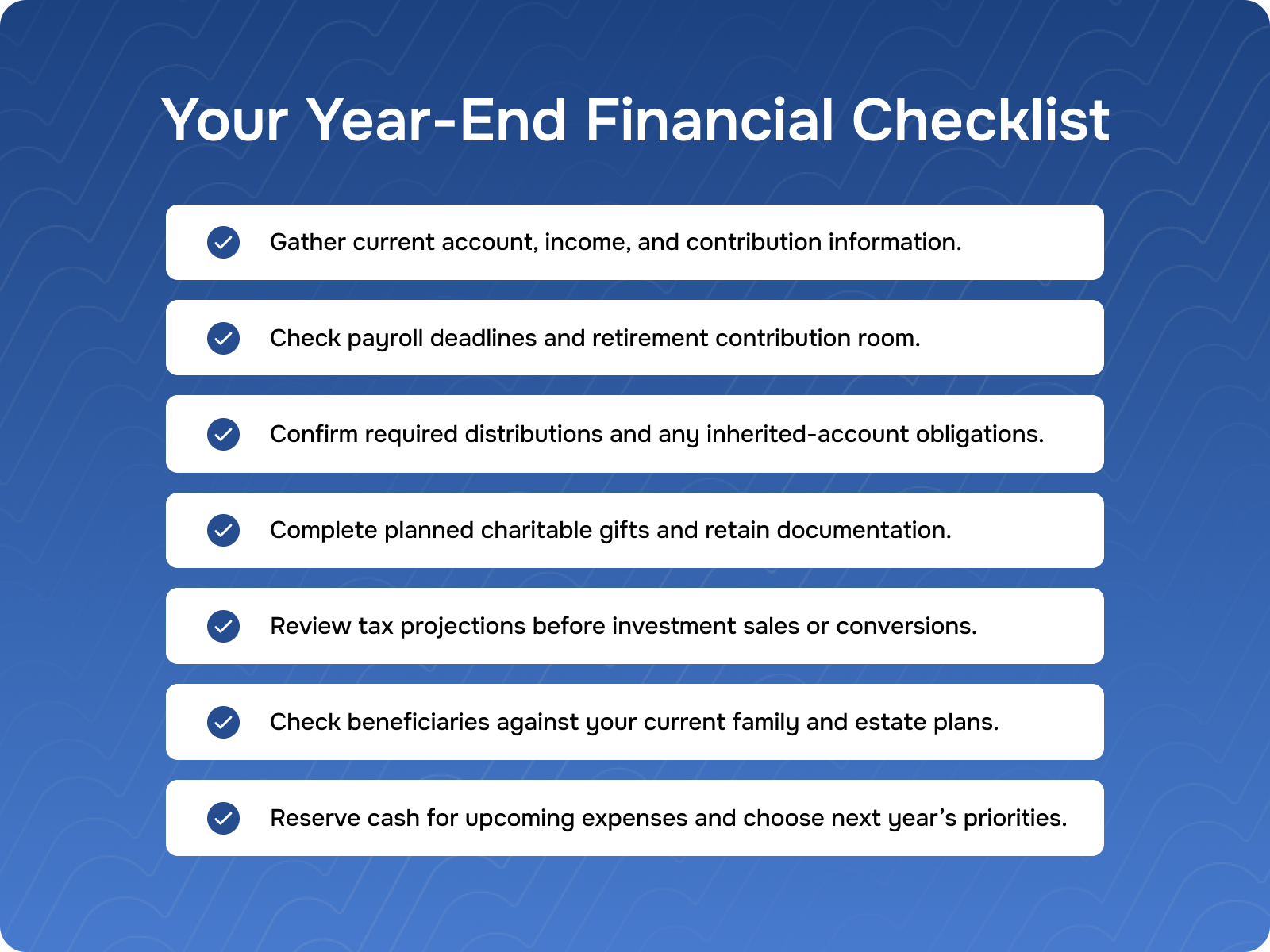
End of year financial planning works best when each decision is considered alongside the others. A larger retirement contribution affects cash flow. A withdrawal can affect taxes. A beneficiary change can affect how the rest of an estate plan works.
Highland Trust Partners can help connect those decisions through comprehensive financial planning and coordinate conversations with your tax and legal professionals. Starting before the holiday rush gives you time to ask questions, confirm deadlines, and move into the new year with a plan that reflects your life today.
More than 99% customer satisfaction is our success.


The expertise and dedication of this team have been game-changers for our business. Highly recommended! Outstanding service! Their innovative approach helped us achieve measurable success in record time

From start to finish, the team provided unparalleled support. They truly understood our needs and delivered results that surpassed our expectations.

The team at exceeded our expectations with their strategic insights and innovative solutions. Their professionalism and dedication to our success were truly remarkable.

Thanks to Casho, we streamlined our operations and achieved our growth goals. Their hands-on approach and expertise made a real difference for our business

From day one, Casho demonstrated professionalism and a genuine commitment to our success. Their innovative approach helped us reach new heights